
From the Diner
Chinese-Made Perfume for Your Own Label: A Country-by-Country Document Map
Own-label perfume made in China does not usually get stuck at the border because of the product. It gets stuck because one document in the set was assumed rather than confirmed: a safety assessment nobody commissioned, an ingredient declaration in the wrong language, a conformity statement that the fragrance house provides but the filler does not. The fix is a document map — a single list of what travels with the goods, who issues each item and which market asks for which part. Build it before the purchase order, not after the container sails.
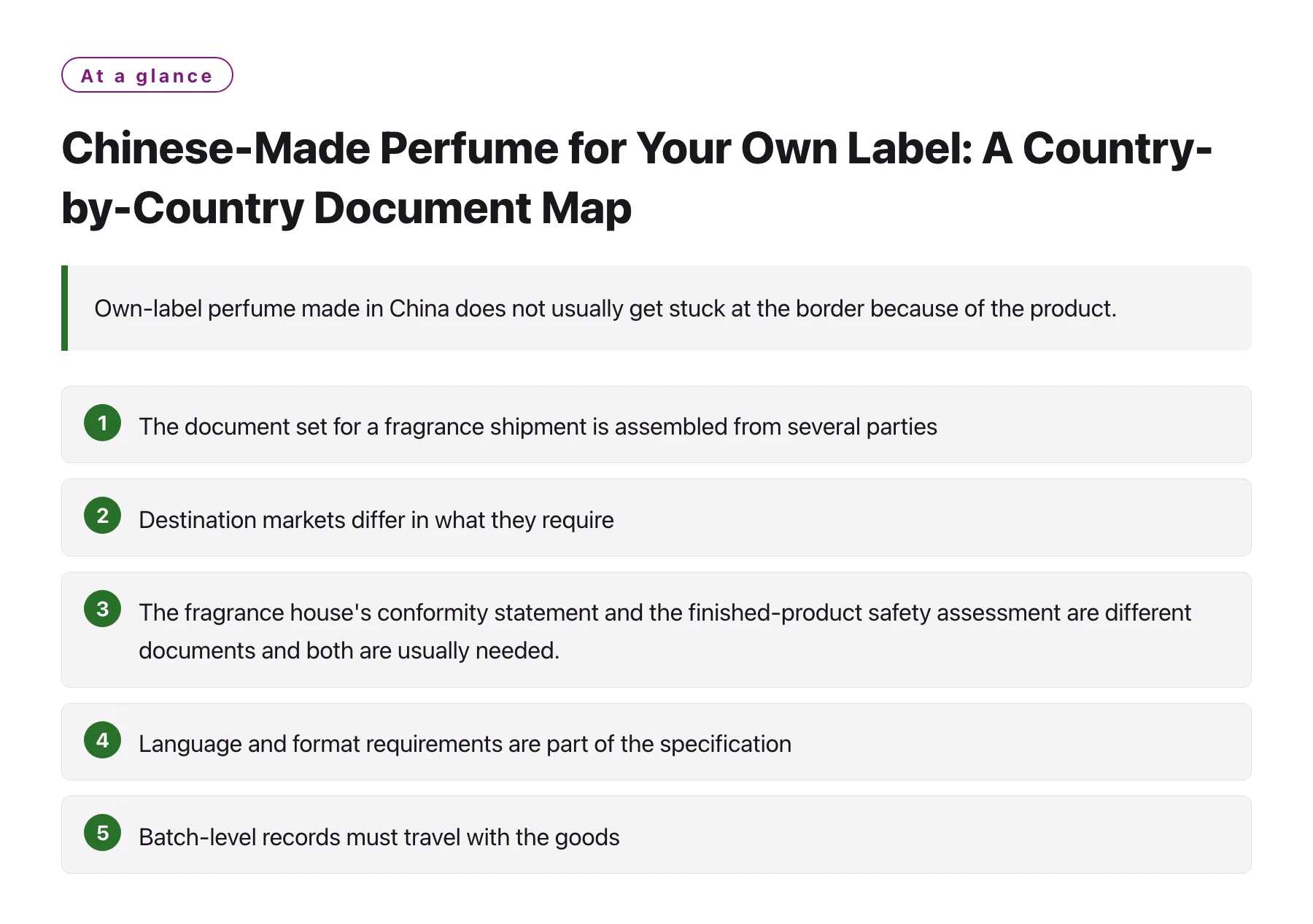
Key takeawaysThe document set for a fragrance shipment is assembled from several parties, so each item needs a named owner before production starts. · Destination markets differ in what they require, so a file that satisfies one market may be incomplete for another. · The fragrance house's conformity statement and the finished-product safety assessment are different documents and both are usually needed. · Language and format requirements are part of the specification, because a correct document in the wrong form still delays a shipment. · Batch-level records must travel with the goods, not be reconstructed from memory after the fact.
A retail own-brand that buys fragrance from a Chinese partner quickly discovers that compliance is not one document but a small library, issued by different parties at different stages. The fragrance house produces the scent and its safety conformity. The filler produces batch records. The brand assembles the product information that its own market requires.
When a shipment is held, the missing item is almost never exotic. It is usually an ingredient list in the wrong language, a safety assessment that was never commissioned because everyone assumed the fragrance house had done it, or a certificate that exists but names a different product version.
This map is written for the retailer's own-brand team that has to collect the file and hand it to a customs broker or a market authority, and who would rather define the list now than negotiate it under time pressure.
What actually travels with a fragrance shipment
Start by separating documents that describe the fragrance from documents that describe the finished product. The first group comes from the fragrance house and covers the compound: its composition information, its conformity with the industry's safety standards and any restriction statements that apply to the materials used [1]. The second group comes from whoever fills the bottle, because the finished article includes the alcohol, the water, the packaging and the labelling.
Confusing the two is the most common source of delay. A conformity statement for a fragrance compound is not a safety assessment for a finished cosmetic product, and a market authority asking for the latter will not accept the former.
Batch records belong with the goods
Every shipment should travel with records that identify the batch: what was filled, when, from which bulk, against which specification and with which release. These records are cheap to produce at the time and expensive to reconstruct later, and they are the first thing a serious buyer or authority asks to see.
Language and format are requirements too
A document that is technically correct but in the wrong language, or missing a required declaration, still holds up a shipment. Write the language and format requirements into the specification and check a sample before the full set is printed or issued.
The document map
| Document | Who normally issues it | What it answers |
|---|---|---|
| Fragrance composition and conformity statement | Fragrance house or its development team | What is in the compound and whether it meets the industry's safety standards |
| Restricted-material confirmation | Fragrance house, sometimes verified by a third party | Whether the formula stays within use limits for the product category |
| Safety assessment for the finished product | Qualified assessor engaged by the brand placing the product on the market | Whether the finished cosmetic product is safe for its intended use |
| Ingredient list and allergen declaration | Brand, based on the formula supplied by the manufacturer | What must appear on the label and in which language |
| Batch record and certificate of analysis | Filling factory | Which batch was shipped and whether it met the specification |
| Manufacturing and quality certificates | Factory, verified by third-party audit where required | Which management systems are in place at the site of manufacture |
| Commercial documents | Brand and freight forwarder | Value, origin, classification and the terms the goods travel under |
Assign a name to every row before the order is placed. Rows with no owner are the ones that go missing, and they are almost always found on the week the goods are due to clear.
Europe: the file behind the label
The European Union's cosmetics framework places the obligations on the entity that places the product on the market, which means a brand importing own-label fragrance carries responsibilities that a factory cannot discharge on its behalf. The arrangements include a responsible person established in the market and a product information file that has to be available for inspection [2].
In practice, the brand commissions the safety assessment and assembles the file, while the manufacturer supplies the technical inputs: formula detail, conformity statements, batch records and the specification. The division is workable only if it is planned, because the assessor usually needs information that only the fragrance house holds.
Ask for the inputs, not the conclusion
Request the raw inputs the assessment depends on — composition percentages where required, restriction statements and material documentation — rather than a summary sentence confirming compliance. An assessor cannot work from a summary, and a market authority will not accept one.
Canada and other destination markets
Other markets follow the same logic with different details. In Canada, cosmetic products sold in the market fall under a notification and disclosure regime administered by the federal health authority, and the requirements are published for importers and manufacturers to work from [3]. The practical implication for an own-brand is the same as in Europe: someone in the brand has to be answerable for the notification, and the information comes partly from the factory.
Where a market is not covered by the two examples above, the pattern repeats. Find the authority's published requirement, identify which items only the manufacturer can provide, and put those into the supplier agreement as deliverables with a deadline. Treating them as favours at shipping time is what turns a compliance question into a delay.
One matrix, several markets
If the same product ships to more than one market, build a single matrix with a column per destination and a row per document. The gaps become visible immediately, and the manufacturer can be asked once for everything rather than in a sequence of small requests.
The document most often missing is the one everyone assumed someone else had commissioned: the safety assessment for the finished product. Factories do not usually issue it, and fragrance houses do not either, because it covers the finished article including alcohol, labelling and pack. Name the owner of that single document in the purchase order, with a due date, and a large share of import delays disappears.
Where the fragrance house fits, and what to ask
A manufacturing partner can make the document set much easier or much harder depending on how it works. A house that develops the fragrance and fills the product in one place can hand over formula inputs, conformity statements and batch records from one quality system, which shortens the chain that the brand has to chase. Buyers looking at contract perfume manufacturing in China should ask directly which documents come with an order as standard and which are charged separately.
Ask the question in written form, and ask for a sample of each document with the quotation. It is surprising how often a supplier's answer changes when a specimen is requested. A partner that already serves export markets will have the set prepared for several destinations, which is a genuine operational advantage rather than a marketing line.
The same conversation is worth having about development. If the scent is developed for the brand, the composition information and restriction statements originate with the developer, so the quality of that documentation follows the quality of the development process. Programs described as an ODM partner for fragrance brands typically keep formula records and revision history as part of their normal workflow, which is exactly what an assessor later needs.
It also helps to know how the wider market is handling this. As Chinese fragrance houses build export programmes, documentation has become part of how they compete, and the shift is visible in how publicly they discuss compliance and how Chinese perfume brands compete internationally. A brand that reads that landscape before negotiating will ask for the right things at the right moment.
Finally, keep the file as a living document rather than a shipment attachment. Formula revisions, artwork versions and batch records accumulate over a range, and a renewal or a new market listing will ask for all of it. The brand's own-brand team, not the factory, ends up owning that archive — and the partner's role is to fill it reliably. A manufacturer that presents itself as Xuelei alongside its own compliance material is inviting exactly that kind of scrutiny, which is a reasonable starting point for the conversation.
Put the documents in the contract
List each document the manufacturer will provide, the language, the format and the deadline, and make it a contractual deliverable rather than a courtesy. In most disputes about a held shipment, the gap is not capability but expectation: nobody wrote down who owed what.
Sources
- IFRA Standards Library (International Fragrance Association) —— The IFRA Standards Library lists the restrictions the fragrance industry applies to individual fragrance ingredients, based on safety assessments; it is the reference point for compliant fragrance formulation.
- European Commission: Cosmetics in the EU —— The European Commission's overview of EU cosmetics rules, including the responsible person, product information file and safety report requirements.
- Health Canada: Cosmetic Safety —— Health Canada's cosmetics pages, covering cosmetic notification, the ingredient hotlist and safety requirements for cosmetics sold in Canada.
Frequently asked questions
What documents should come with own-label perfume made in China?
Fragrance composition and conformity statements, restricted-material confirmation, batch records and certificates of analysis, manufacturing and quality certificates, ingredient and allergen information, commercial documents, and the finished-product safety assessment that the brand normally commissions.
Does the factory provide the safety assessment?
Usually not. The safety assessment covers the finished cosmetic product and is normally commissioned by the entity placing it on the market. The factory supplies the technical inputs the assessor needs, which is why the owner of that document should be named in the purchase order.
Why is a fragrance conformity statement not enough for the EU?
Because it describes the fragrance compound, not the finished cosmetic product. The EU framework places obligations on the entity placing the product on the market, including arrangements such as a responsible person and a product information file covering the finished article.
Are the requirements the same in every market?
No. The logic is similar but the details differ. Canada, for example, operates its own notification and disclosure regime for cosmetics, published by the federal health authority. Build one matrix with a column per destination so the gaps are visible.
Who should own the compliance file inside the brand?
One named person, with the manufacturer as a supplier of defined inputs. Documents arrive from several parties and accumulate across formula and artwork revisions, so without a single owner the file becomes a set of loose emails at exactly the moment it is needed.
Should document requirements be written into the supplier agreement?
Yes. List each item, the language, the format and the deadline, and treat it as a deliverable. Most delays trace back not to a missing capability but to an expectation that was never written down.
Hungry yet? Three decades on Ponce.
The chrome is warm and a booth is open — 24 hours a day, every day of the year.